
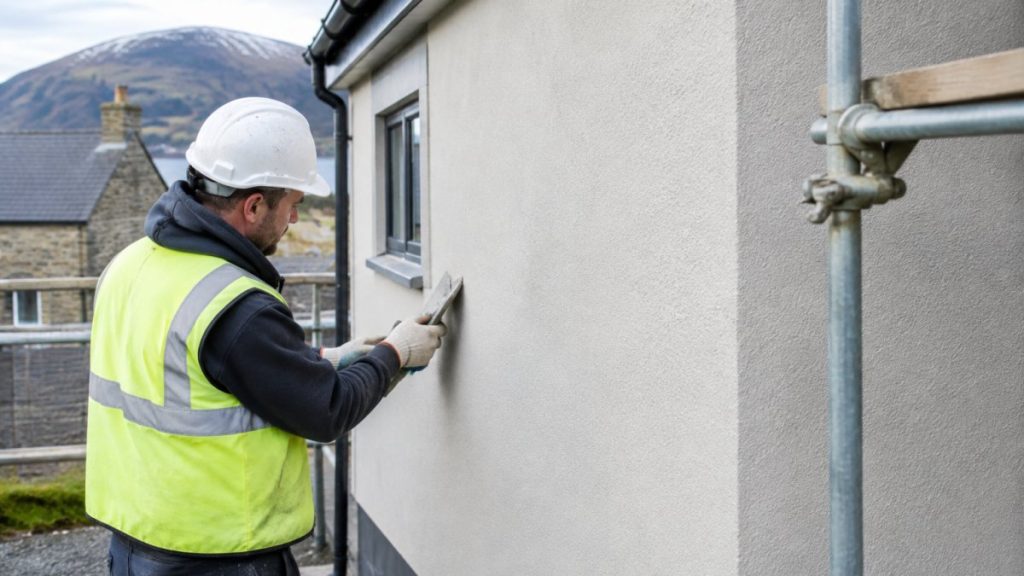
Last Updated: November 20, 2026
Quick Summary
External wall insulation grants in Scotland are available through Home Energy Scotland, which offers up to 75% of combined measure costs capped at a £7,500 maximum grant. Warmer Homes Scotland, ECO4 and council-run Area Based Schemes offer alternative routes for fuel-poor, low-income and targeted-postcode households. Most owner-occupiers should test the national grant and loan route first, as it does not require benefit receipt.
- Warmer Homes Scotland targets fuel-poor households and is assessed on benefit receipt and household circumstances.
- ECO4 places an obligation on energy suppliers to fund efficiency work in low-income homes.
- Area Based Schemes are delivered by local authorities, so your postcode can matter more than your income.
- The application must be submitted and approved before installation starts, as retrospective claims are almost never accepted.
- You must use a TrustMark-registered installer, and work by an unregistered firm will not be funded.
Table of Contents
- Which External Wall Insulation Grants Are Available in Scotland
- How Much Funding You Can Get and What It Covers
- Eligibility Checklist for External Wall Insulation Funding
- The Cost of External Wall Insulation per Square Metre and Your Share
- How Area Based Schemes Insulation Funding Works Locally
- Interest-Free Loans and Combining Funding Sources
- Step by Step: How to Apply for External Wall Insulation Grants
- Stage 1: Confirm eligibility and choose the right route
- Stage 2: Commission a property survey
- Stage 3: Obtain a detailed quote
- Stage 4: Submit the application before work begins
- Stage 5: Wait for approval and funding confirmation
- Stage 6: Book installation with a TrustMark-registered installer
- Stage 7: Keep the certification
- Stage 8: Claim the grant and service any loan
- When Your Property Is Not Suitable for External Wall Insulation
- Get a Quote for Your Insulated Render Project
- Frequently Asked Questions
Which External Wall Insulation Grants Are Available in Scotland
External wall insulation grants in Scotland are the most direct route to cutting heat loss from solid walls, and the landscape of external wall insulation grants in Scotland is broader than most homeowners realise. Many property owners assume support ended years ago. It hasn’t. The Scottish Government channels money through Home Energy Scotland, while local authorities run their own area-based programmes (Energy saving home improvements – Home energy and fuel poverty).
The single biggest mistake we see is treating these schemes as identical. They are not. Each has different eligibility rules, different caps, and different application routes.
Home Energy Scotland Grant and Loan
Home Energy Scotland is the national route, and it is where most homeowners should start. Funding can cover a percentage of combined measure costs up to a maximum grant. Because the cap applies to the combined cost of measures, planning which improvements to bundle matters.
Home Energy Scotland offers a free assessment to help identify suitable improvements.
Warmer Homes Scotland and ECO4
Warmer Homes Scotland targets fuel-poor households, while ECO4 places obligations on energy suppliers to fund efficiency work in low-income homes. Both are more restrictive than the national grant, and both prioritise households on certain benefits. If you do not qualify for either, the Home Energy Scotland grant and loan remains your strongest option.
How Much Funding You Can Get and What It Covers
The headline figures are simple in principle, but what that means in practice is less straightforward, because the cap applies across everything you install together. Check current scheme figures directly with Home Energy Scotland.
| Funding Route | Who It Suits | Cost Coverage | Key Limit |
|---|---|---|---|
| Home Energy Scotland Grant and Loan | Most owner-occupiers | Up to 75% of combined measures | £7,500 maximum grant |
| Warmer Homes Scotland | Fuel-poor households | Fully funded measures | Benefit-based eligibility |
| ECO4 | Low-income households | Supplier-funded | Eligibility assessment required |
| Area Based Schemes | Homes in targeted local areas | Varies by council | Postcode dependent |
Check current limits directly with Home Energy Scotland before you commit, because rules change.
Eligibility Checklist for External Wall Insulation Funding
Most funding pages give a broad list of insulation eligibility and leave you to work out whether external wall insulation specifically qualifies. This checklist is written for external wall insulation, and it separates the requirements that apply to the national grant-and-loan route from those that apply to the fuel-poverty and area-based schemes. Run it honestly before you spend time on an application.
Property requirements
- The property is in Scotland and is your main home or a tenant’s main home
- You own the property, or you are a private landlord with a tenant in place (social housing tenants are usually routed through their landlord)
- The walls are solid stone, solid brick, or a hard-to-treat cavity that cannot be filled with cavity wall insulation
- The property has a valid Energy Performance Certificate, and its rating is below the threshold the scheme requires
- The wall is structurally sound, with no unaddressed movement, severe damp, or defective render
- There is adequate space at boundaries, eaves, and window reveals to accommodate the insulation thickness
- The property is not a listed building and does not sit in a conservation area where external alterations need consent
Applicant and installer requirements
- You have not already claimed funding for external wall insulation on the same property under another scheme
- You will use a TrustMark-registered installer, or an installer certified under the scheme’s own quality mark
- You can provide proof of ownership, proof of occupancy, and a recent EPC
- You are willing to complete the application before any work starts
Scheme-specific eligibility
The national grant-and-loan route is the broadest. It is open to most owner-occupiers and to private landlords, and it does not require you to be on benefits. That is why it is the first route to test.
Warmer Homes Scotland is narrower. It targets households in fuel poverty, and eligibility is assessed against benefit receipt and household circumstances rather than property type alone.
ECO4 is narrower again. It places an obligation on energy suppliers to fund efficiency work in low-income homes, and eligibility is assessed through a combination of benefit receipt, income, and the property’s EPC rating. The supplier, not the homeowner, determines whether a property is eligible under its obligation.
Area Based Schemes do not use a household eligibility test in the same way. They target geographic areas, often selected using fuel-poverty and SAP-rating data, and a property inside the boundary may qualify regardless of the occupant’s income.
The requirements that most often catch people out
The EPC threshold is the first. A property with a rating above the scheme’s cut-off will not qualify for the national grant, even if the walls are solid and the applicant is eligible.
Watch out: a hard-to-treat cavity wall is not the same as a solid wall.
The installer requirement is the second. Work carried out by an unregistered firm will not be funded, and retrospective claims are almost never accepted. Check the installer’s TrustMark registration before you sign anything, not after.
The duplicate-claim rule is the third. You cannot claim the same measure twice, and some schemes exclude homes that have already received support for that measure under any route. Declare every previous award on your application, even if it was for a different measure.
The Cost of External Wall Insulation per Square Metre and Your Share
The cost of external wall insulation per square metre varies with wall area, system type, access, and finish. We do not publish fixed rates, because quoting a single figure would mislead you. What we can say is that the grant covers a percentage of the combined cost, and you pay the balance.
A worked example makes this clearer. If your combined measures total £10,000, a 75% contribution capped at £7,500 would mean a £7,500 grant and a £2,500 homeowner contribution. If the same package cost £12,000, the cap bites: £7,500 grant, £4,500 from you. That is why bundling carefully, and getting an accurate survey first, changes the arithmetic.
How Area Based Schemes Insulation Funding Works Locally
Area Based Schemes insulation funding is delivered by local authorities, not by central government directly. Councils identify target areas, often using fuel poverty data, and then offer funded or part-funded work to homes within those boundaries.
The practical consequence is that your postcode can matter more than your income. A homeowner in a targeted street may get support that an identical property two miles away cannot access. To check availability, contact your local authority’s energy efficiency team directly and ask whether your address falls inside a current Area Based Scheme.
Scottish Government guidance on energy saving home improvements
Interest-Free Loans and Combining Funding Sources
Interest-free loans cover the gap the grant leaves behind. Interest-free loans can help cover the gap the grant leaves behind.
Combining sources is where applications often go wrong. You cannot claim the same measure twice, and some schemes exclude homes that have already received support for that measure. Grant stacking is possible across different measures, not across duplicate claims. Declare every previous award on your application.
Step by Step: How to Apply for External Wall Insulation Grants
Most funding guides list the application steps in a single paragraph. What they do not tell you is how long each stage takes, what the scheme actually checks at each point, and where applications most often stall. This sequence covers the full route from first enquiry to final certification, with the decision points that matter.
Stage 1: Confirm eligibility and choose the right route
Start with the checklist above. The purpose of this stage is not to apply, but to rule routes in or out. Most homeowners find the national grant-and-loan route is the one to test first, because it has the broadest eligibility and does not require benefit receipt. If the household is in fuel poverty, Warmer Homes Scotland may be the better fit. If the property sits inside an Area Based Scheme boundary, the council route may cover more of the cost.
A free Home Energy Scotland assessment is the usual starting point. It confirms which measures the property is suitable for and which funding route fits the household. This stage typically takes a phone call and a short wait for an assessment slot.
Stage 2: Commission a property survey
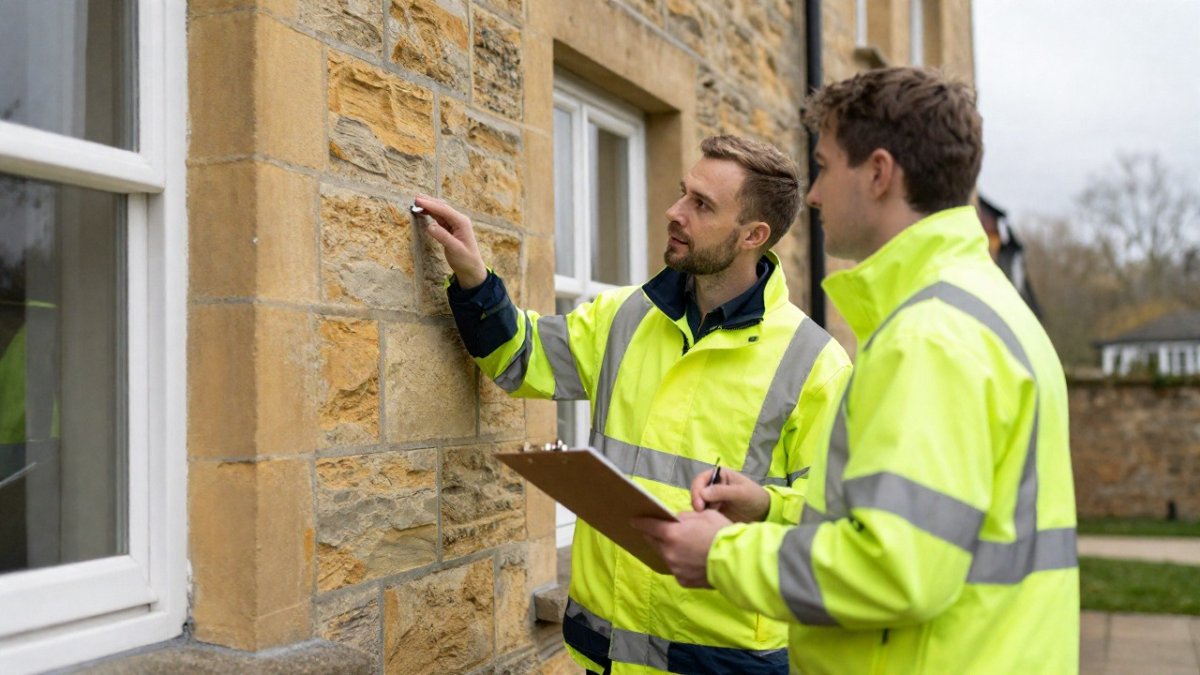
A survey is an important part of most applications. A surveyor checks the wall construction, the condition of the existing render, boundary distances, ventilation, and the detailing at windows, doors, and eaves. The survey confirms whether external wall insulation is technically suitable, and it produces the measurements the installer needs to quote.
Watch out: skipping the survey and applying on the basis of an online estimate is the most common reason applications stall. The scheme needs a measured quote, and the installer needs to know the wall is sound before committing to a price.
Stage 3: Obtain a detailed quote
The quote must cover the full combined package, not just the insulation. That means the insulation system, the render or cladding finish, scaffolding, access, ventilation works, and any making good around windows and doors. If you are bundling other measures, such as loft insulation or a heating upgrade, the quote should show them separately so the scheme can assess the combined cost against the cap.
Stage 4: Submit the application before work begins
This is the step that cannot be reversed. The application must be submitted and approved before installation starts. Work carried out before approval is not funded, and retrospective claims are almost never accepted.
Submit proof of ownership, proof of occupancy, the EPC, the survey, and the quote together. Missing documents are the second most common cause of delay.
Stage 5: Wait for approval and funding confirmation
Approval timelines vary by scheme and by the volume of applications the scheme is handling. The national grant-and-loan route issues a funding confirmation setting out the grant amount, any loan amount, and the conditions attached. Read the conditions before you book installation, because they set out what the scheme will and will not pay for.
Stage 6: Book installation with a TrustMark-registered installer
Once approval is in place, book the installation. Confirm the installer’s TrustMark registration is current and that the certification will be issued in the name the scheme expects. Installation itself usually takes days rather than weeks for a typical house, depending on access and the finish specified.
Stage 7: Keep the certification
The completion certificate, the guarantee, and the updated EPC are the documents that prove the work was done to standard. They matter at resale, and they matter if you apply for further funding later. Store them with the property documents, not in a drawer.
Stage 8: Claim the grant and service any loan
The final stage is the claim. The scheme releases the grant once it has seen the completion evidence, and any loan element is drawn down on the agreed terms. Keep the payment confirmation with the certification.
If you would like to discuss your property, you can contact our team.
When Your Property Is Not Suitable for External Wall Insulation
Not every wall can take external wall insulation. Flats above commercial premises, listed buildings, homes in conservation areas, and properties where boundary distances are too tight all raise problems. So does a wall with structural movement or severe damp that has not been addressed.
This is not a dead end. Insulated render and insulated cladding may be considered where a full external wall insulation system will not fit the constraints.
We would look at insulated render options or insulated cladding systems as practical alternatives before ruling a property out entirely.
Get a Quote for Your Insulated Render Project
Funding decisions hinge on a proper survey and an accurate quote, and that is the part we handle. Render Scotland installs high-performance renders and coatings with insulation products, including K-Rend, insulated cladding, and rainscreen systems, for both domestic and commercial properties.
Render Scotland offers custom solutions tailored to your budget, with a hassle-free experience from start to finish. Visit our insulated render services page to request a free quote.
For background reading on systems and finishes before you decide, our render and insulation blog covers the detail.
The gap between a grant approval and a finished wall is where projects succeed or fail. Get the survey and specification right first, and the funding follows. Render Scotland can assess your property, recommend the right insulated system, and quote for the work so your application rests on real numbers. Get started with Render Scotland and turn a cold solid wall into an efficient, weather-tight exterior.
Frequently Asked Questions
Am I eligible for a grant for external wall insulation?
You usually need to own the property and use it as your main home, and the wall must be suitable for the measure. Support is weighted towards low-income households and homes in fuel poverty, and the work must be done by a TrustMark-registered installer. Because criteria differ between the national grant and loan and local Area Based Schemes, the practical step is to book a free Home Energy Scotland assessment, which confirms what your property qualifies for before you commit to anything.
How much funding is available for home insulation improvements?
Grant support can cover a percentage of combined measure costs, up to a maximum grant. That means the grant is a contribution, not a full payment, and you fund the balance. The cap applies across the measures you install together, so bundling external wall insulation with floor insulation or draught proofing changes how the 75% is calculated. Always confirm current limits with Home Energy Scotland, as scheme rules are reviewed periodically.
What is the difference between the Home Energy Scotland Grant and Loan?
The grant is money you do not repay, awarded against a percentage of eligible costs up to the maximum limit. The loan is separate funding you borrow and repay, which may help cover a larger share of the work than the grant alone. In practice many households use both together: the grant reduces the total, and the loan spreads the remaining homeowner contribution over time. Ask about both in the same application rather than treating them as alternatives.
Are there specific grants for solid wall insulation?
Eligibility for solid wall insulation support depends on property suitability. A technical survey is typically needed to confirm the wall construction, damp risk and detailing before funding is approved.
How do Area Based Schemes work for insulation funding?
Area Based Schemes are delivered by local authorities rather than applied for individually. Local councils may identify areas for support and offer insulation to properties within them. You cannot apply to a scheme that has not selected your area, so the first step is checking your local authority’s website or asking Home Energy Scotland whether an active scheme covers your postcode. If one does, the council manages the installer procurement.
Does the government cover the full cost of external wall insulation?
No. A homeowner contribution is generally required unless a local scheme offers support for eligible households. The balance after any grant may be funded through a loan or savings. Treat any claim of 100% national funding with caution and verify it directly with Home Energy Scotland before signing anything.

